
Comedy is the hardest anime genre to get right. A lot of what gets called comedy anime is really just awkward situations, reaction faces, and characters yelling at each other. Real comedy — the kind where jokes land because of character, timing, and genuine surprise — is rare in any medium. Anime is no exception.
But when anime gets comedy right, it does it better than almost anything else. The best comedy anime build characters so specific and consistent that you can predict how they will respond to any situation, and then the joke is watching them respond exactly that way and finding it funnier every time.
Here are the comedy anime that actually made me laugh out loud.
1. Gintama (2006–2018)
Gintama is the funniest thing I have encountered in any medium. I am not exaggerating when I say that.
It is set in an alternate Edo-period Japan that has been invaded by aliens. Gintoki Sakata, a former samurai who fought in the alien war and lost, now runs an odd-jobs business with two apprentices. Most episodes are standalone comedy sketches. Some are extended parody arcs that methodically destroy other anime franchises. And then, completely without warning and with no tonal transition whatsoever, the show pivots into some of the most emotionally devastating action storytelling in all of anime.
The humor is very Japanese — there are puns and wordplay and references to nineties Japanese pop culture that will not land for every international viewer. You will miss some jokes. You will still laugh at most of them, because the physical comedy and character work are universal. Gintoki's absolute shamelessness, Shinpachi's mounting exasperation with everyone around him, Kagura's complete disregard for social norms — these are comedy dynamics that work in any language.
The serious arcs, when they come, are extraordinary. Yoshiwara in Flames. Rakuyo. The finale. The contrast between the comedy and the drama makes both parts better than they would be separately.
Start at episode one. Commit to getting through episode fifty before you evaluate whether it is for you.
Episodes: 367 + movies | Genre: Comedy, Action, Parody
---
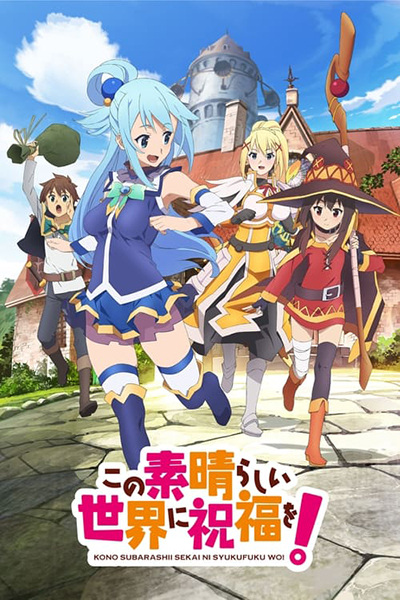
2. Konosuba (2016–2017)
Konosuba is the anti-isekai and it is a masterpiece of the format.
Kazuma dies a genuinely embarrassing death and gets sent to a fantasy world to defeat a Demon Lord, as is traditional. He gets to bring one item with him. Looking at the goddess who is processing his transfer — the arrogant, self-satisfied Aqua — he decides to bring her. She is furious. She turns out to be essentially useless at everything her divine status implies.
The party that forms around them is one of the great comedy ensembles in anime. Megumin is a mage who can cast exactly one explosion spell per day, after which she falls over and cannot move. Darkness is a crusader who is terrible at actually hitting anything but loves getting hit, which she pursues with concerning enthusiasm. Every combination of these four specific people in any given situation produces a perfectly calibrated disaster.
The humor in Konosuba works because it comes entirely from character. You understand exactly why these specific people would produce exactly this specific outcome, and the anticipation of that outcome is half the joke. Season 2 is as good as Season 1. The movie is excellent. Season 3 continues the quality. Watch all of it.
Episodes: 20 + movie | Genre: Comedy, Fantasy, Isekai
---
3. Ouran High School Host Club (2006)
Ouran Host Club is technically a romantic comedy, but the comedy so thoroughly dominates that the romance becomes almost incidental. Haruhi Fujioka accidentally breaks an eight-million-yen vase at her school's host club — where beautiful boys entertain female clients — and has to join the club to repay the debt.
The show has a wonderful, precise self-awareness about romance anime tropes. It knows exactly what genre it is operating in and it uses that knowledge to mock itself constantly and cheerfully. The host club archetypes — the princely type, the cool type, the little boy type, the twins — are acknowledged as performances by the characters themselves, which creates a constant ironic distance between the show and its own conventions.
Haruhi is one of my favorite comedy protagonists in anime. She is completely unimpressed by wealth, completely unbothered by chaos, and extremely competent in quiet ways that every other character keeps failing to notice. Her total immunity to the drama around her is the joke that never stops paying off.
Episodes: 26 | Genre: Comedy, Romance, School
---
4. The Disastrous Life of Saiki K. (2016–2019)
Saiki K. is an all-powerful psychic who wants nothing more than to be a completely invisible, ordinary person. He can read minds, teleport, stop time, change the weather, bend spoons with his brain — and his only goal with all of this is to eat his pudding cup in peace.
The comedy is relentless and fast. Episodes are broken into short sketches with no downtime between jokes. Saiki's deadpan narration provides a constant second track of commentary on the absurdity happening around him. The supporting cast each have exactly one defining trait — the delusional protagonist, the overbearing friend, the dangerous man who thinks he is ordinary — and the show keeps finding new angles on these traits without ever exhausting them.
It is on Netflix. Watch it in Japanese — Saiki's flat, uninflected narration is part of the joke and the Japanese voice performance is perfect for it.
Episodes: 120 short episodes | Genre: Comedy, Supernatural, School
---
5. Daily Lives of High School Boys (2012)
Daily Lives of High School Boys has no ongoing plot. It is purely comedy sketches about three boys and their classmates navigating daily life with escalating absurdity. Each segment is short — three to five minutes — and completely self-contained.
Some individual segments in this show are the funniest things in anime. The "Dramatic River" bit, in which two boys sit by a river trying to have a cinematic dramatic moment and keep failing for increasingly specific reasons, is a genuinely great piece of comedy writing. The "Funky High School Girl" segments are so committed to their premise that they loop back around from dumb to brilliant.
If you want something with no investment required, no plot to track, and consistent laughs, this is the best option in the genre.
Episodes: 13 | Genre: Comedy, School, Slice of Life
---
6. Grand Blue (2018)
Grand Blue is about a university student who moves to a seaside town for college, joins a diving club, and immediately discovers that the diving club's primary activity is getting extremely drunk and wrestling naked. He wanted to learn to dive. He barely dives in the entire series. He is mostly just trying to survive his new social circle.
The humor is loud, physical, and built on the chaos of a group of young people who have not yet figured out that their behavior has consequences. If you have spent time in a university setting with a tight-knit group of idiots who love each other, Grand Blue will feel uncomfortably familiar. The actual diving content, when it eventually appears, is well-researched and beautifully animated. The show earns its legitimacy as a diving anime even while spending most of its runtime not diving.
Episodes: 12 | Genre: Comedy, Slice of Life, Romance
---
7. Prison School (2015)
Prison School is not for everyone. It is extremely ecchi and the humor is deliberately transgressive in ways that not all viewers will be comfortable with. But if you are okay with that, it delivers some of the most committed comedy writing in anime.
Five boys at a formerly all-girls school get caught peeping and are sentenced to serve time in an on-campus prison run by the school's shadow student council. What follows is the most elaborate and self-serious escape attempt in anime history, treated with the gravity of a war film.
The comedy works because the show never acknowledges that any of this is ridiculous. The student council president is played completely straight as a terrifying antagonist. The boys strategize as though their stakes are real. The gap between how seriously everyone takes the situation and how objectively absurd the situation is does most of the comedic work.
Episodes: 12 | Genre: Comedy, Ecchi, School
---
Where to Start
Konosuba is the easiest entry point — short, self-contained, immediately funny without requiring any prior anime knowledge. Saiki K. if you want something even shorter and faster. Gintama if you are ready to commit to something that will take months and reward every minute of it.
Comedy anime rewards watching broadly. The parodies land harder when you understand what is being parodied. But even if you do not, character-driven comedy like Konosuba and Saiki K. is funny on its own terms. Start there and see where it takes you.