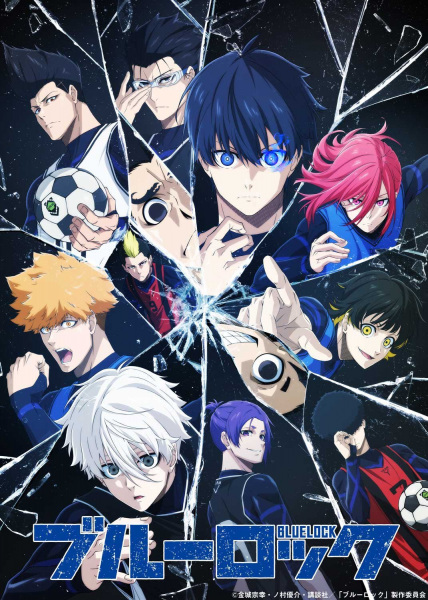

Blue Lock opens with a thesis statement disguised as a sports premise: Japan keeps failing at the FIFA World Cup because it has never produced a world-class egoist striker. The fictional Japan Football Union responds by locking 300 of the country's best high school strikers in a facility designed to crush teamwork and forge one supreme goal-scorer. It is a deliberately provocative idea, and it is the engine that makes the anime so addictive.
But here is a question the anime invites you to ask: would the Blue Lock philosophy actually win a real World Cup? As both an anime fan and someone who watches a lot of actual football, I find the comparison genuinely fascinating. Let us put Blue Lock's fictional logic side by side with how real World Cups are actually won.
The Blue Lock Thesis
Blue Lock's argument, voiced by the program's architect Jinpachi Ego, is that football has over-prioritized harmony, selflessness, and team chemistry — and that this culture has produced technically excellent but ultimately toothless Japanese teams. His solution is the striker as a predator: someone whose hunger to score overrides everything, who will take the shot instead of passing, who treats teammates as tools for his own goals.
The anime dramatizes this through a brutal elimination tournament where players must out-score and out-survive each other. Cooperation exists only as temporary alliance. The message is that greatness comes from individual ego, not collective effort.
It is a thrilling narrative device. As football analysis, it is half right and half deliberately exaggerated for drama.
How Real World Cups Are Actually Won
Look at the last several World Cup winners and a different pattern emerges. Real champions are built on structure, depth, and a balance between individual brilliance and collective organization.
France won in 2018 with a young, devastatingly direct team, but their foundation was defensive solidity and midfield control — Kylian Mbappé's individual genius mattered enormously, but it operated inside a system. Argentina won in 2022 with Lionel Messi at the absolute peak of his powers, the closest thing reality offers to a Blue Lock egoist, yet that team won because of a collective that organized itself around him, not because he ignored his teammates.
The pattern across modern football history is clear: you need elite individuals AND a functioning system. The egoist striker who refuses to play within a structure does not lift trophies in reality. He gets marked out of games by disciplined defenses.
Where Blue Lock Is Actually Right
That said, Blue Lock is not pure fantasy. There is a real truth buried in its exaggeration.
Elite strikers genuinely do need a kind of ruthlessness that pure team players lack. The greatest goal-scorers — Ronaldo, Lewandowski, Haaland — share a selfishness in front of goal that lesser players do not have. They want the ball, they back themselves to score, and they are not interested in passing when they can shoot. In the penalty box, ego wins games. Blue Lock captures that psychological truth even as it exaggerates the surrounding philosophy.
Erling Haaland is, in many ways, a real-world Blue Lock striker. His entire game is built around being in the right place to finish, around a predatory instinct for goals, around a refusal to be anything other than the man who scores. Blue Lock would love Haaland.
So the anime is right that you need that killer instinct. It is wrong that you can build an entire winning team out of nothing but killer instinct.
The Tactical Reality Blue Lock Ignores
The biggest thing Blue Lock leaves out is that modern football is won in midfield and defense as much as in attack. The World Cup-winning teams of the last two decades have been defined by their ability to control games, press effectively, and defend as a unit.
Spain's 2010 World Cup win was built almost entirely on midfield control — possession, patience, and suffocating the opponent. That team scored only eight goals in seven matches and won the final 1–0. By Blue Lock logic, that team should not have won anything. In reality, it was one of the most dominant tournament performances ever.
Blue Lock's striker-obsessed worldview would have no answer for a team like that. You cannot ego your way past a defensive and midfield structure that simply does not give you the ball.
What the Comparison Teaches Us
The fun of comparing Blue Lock to the real World Cup is that the anime works precisely because it pushes a real idea to an unreal extreme. Japanese football really has historically valued harmony in ways that sometimes blunted its attacking edge. Strikers really do need a selfish streak. Individual genius really does decide knockout games.
Blue Lock takes those grains of truth and inflates them into a deliberately one-sided philosophy because one-sided philosophies make for gripping drama. Nobody wants to watch an anime about a balanced 4-3-3 with good defensive transitions. They want to watch teenagers with monstrous egos trying to devour each other for the right to be the one who scores.
The real World Cup, meanwhile, rewards the boring virtues Blue Lock dismisses: organization, depth, defensive discipline, and a system that lets individual genius flourish without depending on it entirely.
Could a Blue Lock Team Win the World Cup?
Imagine a real national team built entirely on the Blue Lock philosophy — eleven egoists all hunting personal glory. It would be electrifying for twenty minutes and then it would concede four goals because nobody tracked back, nobody covered, and nobody trusted anyone else to do their job.
The honest answer is that the Blue Lock striker would be a phenomenal asset inside a real World Cup-winning team, but the Blue Lock philosophy applied to an entire team would be a disaster. The anime knows this on some level, which is why its later arcs increasingly show that even its egoists have to learn when to use their teammates. Even Blue Lock cannot fully escape the truth that football is a team sport.