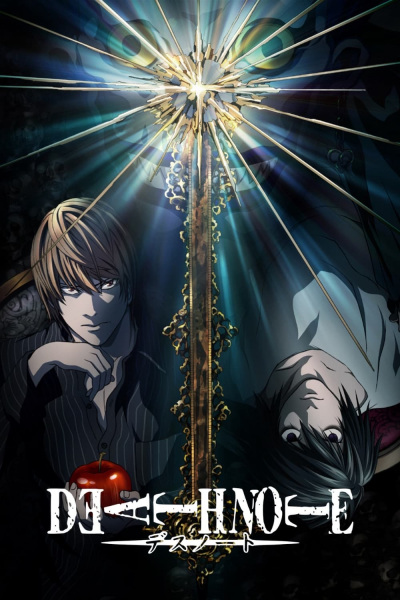

Every few years I rewatch Death Note expecting it to have aged — for the mind games to feel quaint, for the edgy 2006 aesthetic to creak. It never does. Nearly two decades after it aired, Death Note remains the single best gateway anime ever made and one of the tightest thrillers in the medium, full stop. If you have never seen it, or you know it only through memes, this guide covers what it is, why it endures, and how to watch it correctly in 2026.
The Premise
Light Yagami is a brilliant, bored, top-of-the-nation high school student who finds a notebook dropped in a schoolyard. The rules written inside are simple: the human whose name is written in this note shall die. It belongs to Ryuk, a shinigami — a death god — who dropped it into the human world purely because he was bored.
Most stories would make this a corruption arc. Death Note's masterstroke is that Light needs about two days to decide he is going to execute every criminal on Earth and rule the cleansed world as its god. The corruption arc already happened; we just watch the consequences. Within weeks, the world has noticed that criminals are dying of heart attacks, given the invisible executioner a name — Kira — and the world's greatest detective, an anonymous, sleepless, sugar-addicted enigma known only as L, has taken the case.
What follows is not a battle of powers but a battle of procedures: two geniuses trying to deduce each other's identity, where Light's victory condition is a name and L's is proof. It remains the best cat-and-mouse game ever animated.
Why It Still Works
The rules are airtight. The notebook's mechanics are laid out like a legal document, and the show plays completely fair with them. Every scheme, every trap, every reversal is built from rules you already know. When a twist lands, your reaction is never "that's cheating" — it is "how did I not see that."
Both leads are magnetic. Light is one of fiction's great villains precisely because he is the protagonist — charming, disciplined, genuinely convinced of his righteousness, and rotting from the first episode. L is his perfect opposite: unkempt, socially alien, and just as ruthless behind the politeness. The series understands they are mirror images, two people who believe they are justice, and it never tells you which one to root for.
It moves. Thirty-seven episodes, no filler, no tournament arcs, no power creep. Madhouse's direction turns people writing in notebooks and eating cake into white-knuckle television — the famous potato chip scene is a masterclass in making the mundane operatic.
Ryuk is the secret ingredient. The shinigami who started everything spends the series eating apples and watching from the ceiling, and he is quietly the show's thesis. Ryuk is the audience: amoral, entertained, invested in nobody. His bookend scenes — the notebook's first drop and his final conversation with Light — frame the entire story as exactly what it was for him, a way to kill boredom. There is something genuinely unsettling about how comfortable that framing feels from the couch, and I am convinced it is intentional.
The Second Half Debate
Honesty requires addressing it: partway through, the story makes a structural choice so bold it splits the fandom to this day. Some fans think the show never recovers; others think the final episodes justify everything. I will not spoil the specifics. My view after multiple rewatches: the back half is weaker, but the last two episodes are among the best endings in anime — the story follows its premise to the only honest conclusion it could have, and the final scene is perfect. Do not let anyone tell you to stop early.
How to Watch It in 2026
The main series — 37 episodes from Madhouse, 2006-2007 — is the only essential item, and it streams on Netflix and other major services depending on region, with both an excellent English dub and the original Japanese. The dub, featuring Brad Swaile as Light and Alessandro Juliani as L, is one of the all-time greats; this is a rare show I recommend either way without hesitation.
You can safely skip the two Relight compilation films (condensed retellings), the Japanese live-action films (fun curiosities), and the 2017 American Netflix film (a warning about adaptation, not an adaptation). The one-shot manga sequel from 2020 is a clever afternoon read after you finish.
If you finish and want more, the obvious next steps are Code Geass (Light's ambition at anime-opera scale), Monster (the L-vs-Light dynamic played with total realism), and Terrace of... just kidding — watch Monster.