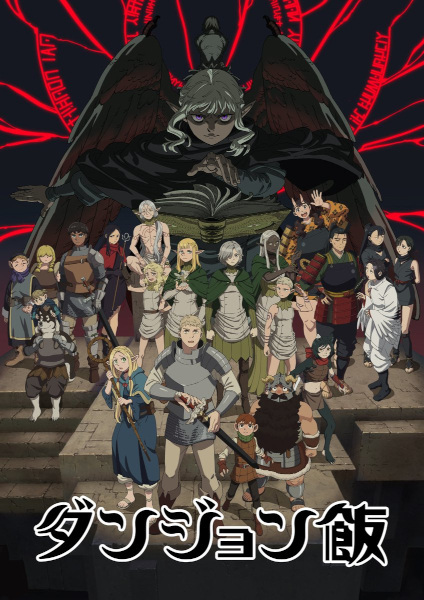

Delicious in Dungeon, released in Japan as Dungeon Meshi, is an anime that is very easy to undersell and very difficult to overpraise. The description — adventurers survive in a dungeon by cooking and eating the monsters they defeat — sounds like a gimmick. It is not a gimmick. It is one of the most carefully constructed, thematically rich, and genuinely moving anime produced in the last decade.
I am not being hyperbolic. Delicious in Dungeon won multiple anime of the year awards for 2024, was one of the most discussed anime of its year among both casual and dedicated fans, and is still being recommended as a first-watch for people new to anime in 2026. That longevity is not accidental. This is a show that earns its reputation at every level.
What Delicious in Dungeon Is About
Laios Touden leads a party of adventurers. His sister Falin is consumed by a dragon on a dungeon run gone wrong. Laios has to rescue her before she is fully digested, which means he needs to reach the bottom of the dungeon quickly without the resources for proper supplies. His solution: eat the monsters.
The premise is executed with absolute seriousness. Delicious in Dungeon is a cooking show, an adventure show, an ecology documentary about fantasy monsters, and eventually a profound story about mortality, consumption, identity, and what it means to be alive. It is also consistently funny. The show manages all of these simultaneously without any of them undermining the others, which is a feat of writing that is much harder to achieve than the result makes it look.
The Cooking as Worldbuilding
The genius of Delicious in Dungeon's premise is that it forces the world-building to be specific rather than generic. When Laios decides to cook a monster, the show has to answer questions: What does this creature eat? How does its body work? What would make sense to eat and what would not? How would you prepare it?
Answering those questions consistently and thoughtfully, across dozens of different creatures throughout 24 episodes, requires the author (Ryoko Kui, who wrote and drew the manga for nine years) to have thought deeply about how the dungeon works as an ecosystem. Every meal teaches you something about the dungeon. The food is never just food — it is the show's mechanism for explaining how this world operates and what lives in it.
This approach pays dividends later when the show's deeper themes come into focus. The dungeon is a place where things are eaten and become other things. The cycle of consumption and transformation is the show's actual subject, and the cooking establishes that subject in episode one without announcing it.
The Characters
Laios is one of the most distinctive protagonists in recent anime. He is genuinely strange — obsessed with monsters to a degree that his companions find unsettling, lacking social awareness in specific ways, and fundamentally more interested in creatures than in people. He is also deeply loving in his own way, completely dedicated to saving his sister, and capable of perception that others miss precisely because he thinks about things differently.
Chilchuck is the party's lockpick, a halfling who is significantly older than he looks. His expertise is traps, and his arc is about expertise — what it means to be genuinely good at something and what the limits of skill are. He is the most practically-minded character and often the most grounded voice in the group.
Marcille is the elven mage and the character the audience is most often meant to identify with initially — she is the most normal in her reactions to the cooking, the most resistant to the premise, and over the course of the series she becomes the most important character to the story's main theme. Her arc is one of the best in the series.
Senshi is the dwarf who teaches the party how to cook. He has lived in the dungeon for years and knows it more intimately than anyone. His enthusiasm for the food is genuine and his knowledge of the dungeon is encyclopedic. He becomes the emotional heart of the group.
The Studio Trigger Difference
Trigger animated Delicious in Dungeon and made specific choices about how to present the food that were essential to the show's success. The cooking sequences are animated with the same care and attention as the action sequences. The food looks genuinely appetizing even when what is being cooked is a walking mushroom or a troll. The color design for the dishes is warm and inviting in a way that makes the absurd premise feel real and appealing.
The creature designs are similarly excellent. Every monster in Delicious in Dungeon is based on a specific ecological niche — what does this thing eat, what eats it, how does it reproduce — and Trigger's design work makes that legible visually. You can look at most Dungeon Meshi monsters and understand their diet and behavior from how they look.
The Deeper Themes
I want to be careful about spoilers here, because part of what makes Delicious in Dungeon great is how its themes develop naturally from the premise without feeling like they were imposed on it.
What I can say: the show is ultimately about the violence inherent in survival, about what we owe to the things that sustain us, about how we remember and honor what we consume, and about what it means to be changed by what we take in. These themes are earned through 24 episodes of establishing the world and its rules, and when they arrive they feel inevitable rather than surprising.
The final arc is one of the most emotionally complete conclusions in recent anime. It does not betray what came before it. It deepens it.
Should You Watch Delicious in Dungeon?
Yes. Unless you have a specific reason not to (the cooking of creatures bothers you on a conceptual level, or you have no interest in fantasy settings), Delicious in Dungeon is one of the safest recommendations I can make for any anime viewer.
It is accessible to people who do not watch anime regularly. It is rewarding for longtime fans who want something with genuine depth. It holds up on rewatch. The 24-episode run is self-contained — the manga concluded and the anime adapts it completely, with a beginning, middle, and end.
Watch the first three episodes. If you are not hooked by the end of the third episode, the show is probably not for you. Most people are hooked by the end of the first.
Where can I watch Delicious in Dungeon? It is available on Netflix globally.