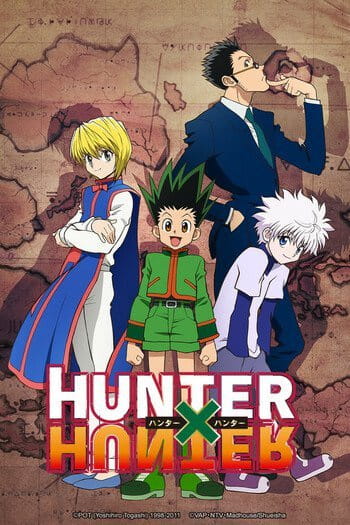

Hunter x Hunter has two anime adaptations and one of the most acclaimed storylines in all of shonen manga. If you are coming to it for the first time, you need to know which version to watch, what order to watch it in, and what to expect from each arc. This guide covers all of it.
Which Version: 1999 or 2011?
This is the first question new viewers ask. Here is the simple answer: start with the 2011 remake.
Hunter x Hunter (2011) — 148 episodes, produced by Madhouse. Covers the entire manga up to the Chimera Ant arc conclusion. Better animation, better pacing, more faithful adaptation. This is the version recommended by almost everyone.
Hunter x Hunter (1999) — 62 episodes + OVAs, produced by Nippon Animation. Covers the manga up to the end of the Greed Island arc, with some differences in execution. The 1999 version has a different tone — darker and slightly more horror-adjacent in places. Some fans prefer it for specific arcs.
Recommendation: Watch 2011 first. If you love it and want more, the 1999 version covers the same material with different creative choices and is worth watching for comparison.
The 2011 Watch Order
The 2011 series is clean — no filler arcs, no movies required, just 148 consecutive episodes. Here is what each arc covers:
1. Hunter Exam Arc (Episodes 1–21)
Twelve-year-old Gon Freecss wants to become a Hunter — a licensed professional with access to restricted areas, resources, and privileges — to find his father Ging, who abandoned him as a baby and became a legendary Hunter. Gon takes the Hunter Exam, where he meets Killua, Kurapika, and Leorio — the friends who will define the rest of the series.
The Hunter Exam arc establishes the tone perfectly: clever challenges, genuine danger, and characters who feel distinctive from their first appearance. It is one of the best opening arcs in shonen anime.
2. Zoldyck Family Arc (Episodes 22–26)
A short arc following the exam. Gon, Leorio, and Kurapika travel to the Zoldyck estate to rescue Killua, who has been taken home by his family of professional assassins. Introduces the Zoldyck family dynamics and gives Killua more depth.
3. Heaven's Arena Arc (Episodes 27–36)
Gon and Killua travel to Heaven's Arena — a 251-floor tournament building where fighters earn money by winning matches. This is where Nen is introduced: the ability to channel and manipulate one's life energy. The Nen system is one of the most creative and flexible power systems in shonen anime and everything that follows depends on understanding it.
4. Yorknew City Arc (Episodes 37–58)
The Yorknew City arc is the first masterpiece arc of the series. Kurapika hunts the Phantom Troupe — the thieves who murdered his clan and stole their eyes. The Phantom Troupe are one of the greatest antagonist groups in anime: capable, funny, genuinely threatening, and complex enough that you almost root for them.
This arc introduces moral ambiguity in ways the Hunter Exam does not. Kurapika's revenge mission is understandable and also dangerous. The Troupe's leader Chrollo is compelling and frightening. Nothing resolves cleanly.
5. Greed Island Arc (Episodes 59–92)
Gon and Killua enter Greed Island — a video game that exists in physical space — to find clues about Ging. It is lighter in tone than Yorknew City, with more emphasis on clever game-playing and character bonding. Features one of the best training sequences in shonen anime.
6. Chimera Ant Arc (Episodes 76–136)
The Chimera Ant arc is one of the greatest extended story arcs in all of anime. It is also the longest and most demanding — 60+ episodes that ask real patience, especially in its first half.
Chimera Ants are a species that can absorb genetic traits from the creatures they eat. After eating humans, they begin producing offspring with human intelligence and superhuman physical abilities. The most powerful of these, called the King (Meruem), becomes the central character of the arc's latter half.
What makes the Chimera Ant arc extraordinary is Meruem's story. He is introduced as a monster and becomes, through a series of board game matches with a human girl named Komugi, something far more complex. His relationship with Komugi is one of the most unusual and moving things in anime.
7. 13th Hunter Chairman Election Arc (Episodes 137–148)
The final arc of the 2011 anime is a quieter, character-focused conclusion that wraps up the immediate narrative. It does not conclude Gon's search for his father — the manga continues beyond what the anime covers — but it provides a satisfying emotional endpoint.
The OVAs and Films
Hunter x Hunter: Original Video Animation (1998–2004) — These OVAs cover the same material as the 2011 anime but from the 1999 perspective. Not required if watching 2011.
Hunter x Hunter: Phantom Rouge (2013) — A non-canon film set during the Yorknew City period. Fun but not required. Watch after finishing the main series.
Hunter x Hunter: The Last Mission (2013) — Another non-canon film. Watch after finishing the series.
What Comes After the 2011 Anime?
The manga continues beyond episode 148. The Succession War arc and the ongoing Voyage arc in the manga cover new material. Unfortunately, author Yoshihiro Togashi has a long history of health-related hiatuses — the manga has been on pause for extended periods and progress is slow.
As of 2026, no new anime adaptation of the post-2011 material has been announced.