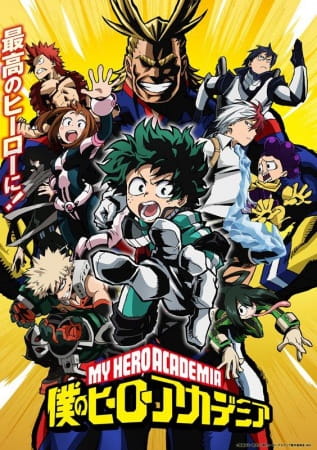

My Hero Academia has been running since 2016 and has accumulated a considerable amount of content — seven television seasons, three theatrical films, multiple OVA episodes, and spin-off material. If you are starting fresh or returning after a long break, having a clear watch order makes a significant difference.
Here is the complete guide, with honest notes on what is worth your time and what you can safely skip.
What Is My Hero Academia?
In a world where roughly 80% of people are born with superpowers called Quirks, Izuku Midoriya belongs to the other 20%. He has no power. He wants, more than anything, to become the greatest hero alive — specifically to be like All Might, the Symbol of Peace, who represents the pinnacle of what a hero can be.
When Midoriya encounters All Might during a moment of genuine crisis and shows him what it means to run toward danger without thinking about yourself, All Might decides to pass his power — One for All, a transferable ability that stockpiles strength across generations — to this Quirkless boy who does not know how to stop wanting to help people.
The series follows Midoriya through U.A. High School, a prestigious academy that trains future professional heroes, as the threats facing hero society escalate from academic competitions to a war that questions whether the entire system is worth defending.
The Complete Watch Order
Season 1 (2016) — Episodes 1–13
Start here without exception. Season 1 covers Midoriya's origin — meeting All Might, receiving One for All, surviving the U.A. entrance exam, and beginning his first year. It is shorter than subsequent seasons and primarily focused on establishing the world and characters.
The foundation it lays is essential. The rivalry with Bakugo, the nature of One for All, the structure of hero society, and the first appearances of the villain faction all happen here.
Season 2 (2017) — Episodes 14–38
Season 2 is where the show becomes exceptional. It opens with the U.A. Sports Festival — an extended tournament arc that gives almost every character in Class 1-A a meaningful moment and introduces several important recurring characters.
The arc that follows, featuring the villain known as the Hero Killer Stain, is the best single arc in the series' early seasons. Stain's ideology — that most professional heroes are frauds motivated by money and fame rather than genuine selflessness — is coherent enough to be uncomfortable. His encounter with Midoriya, Iida, and Todoroki forces all three of them to examine what they are actually fighting for.
This is the best season of the show. If you are evaluating whether MHA is for you, the Stain arc is the argument it makes.
My Hero Academia: Two Heroes (Film, 2018)
Takes place between Seasons 2 and 3. Non-essential — nothing in this film affects the main story — but it is enjoyable, has a strong villain concept, and gives both Midoriya and All Might moments that develop their relationship beyond what the TV series covers at this point.
Watch it after Season 2 if you want more content. Skip it if you want to go straight to Season 3.
Season 3 (2018) — Episodes 39–63
Season 3 opens with the Forest Training Camp arc — the League of Villains attacking Class 1-A during a training exercise — and escalates into the Hideout Raid, which is the most serious conflict the series has produced to this point. Characters get hurt in lasting ways. The threat level ratchets up significantly.
The Provisional Hero License Exam arc in the second half introduces Class 1-B and the high school students from other academies, expanding the world beyond U.A. in useful ways.
Season 4 (2019–2020) — Episodes 64–88
Season 4 is the most divisive season among the fanbase. The Overhaul arc deals with a villain running an operation that weaponizes children, specifically a girl named Eri whose ability to rewind biological states has been harvested in ways that are genuinely disturbing. It is darker than anything previous.
The cultural festival arc in the second half is a dramatic tonal shift — lighter, warmer, and focused on a Class 1-A concert that serves as a character moment for several people simultaneously. Some viewers found this shift jarring after the Overhaul arc. I found it earned.
Season 5 (2021) — Episodes 89–113
Season 5 is broadly considered the weakest of the main seasons. The Joint Training Battle arc — Class 1-A versus Class 1-B in a series of mock battles — is entertaining but inconsequential.
The significant content in Season 5 is the Endeavor Agency internship arc and the setup for the Paranormal Liberation War that Season 6 opens with. Episode 113 is a remarkable standalone episode about Hawks — one of the supporting characters — doing something morally difficult for reasons that are clearly justified and clearly wrong at the same time.
If you are feeling impatient, you can watch episodes 89–91, skip to episode 104, and then watch straight through to the end of Season 5. You will miss the Joint Training battle but nothing essential.
My Hero Academia: Heroes Rising (Film, 2019)
Significantly better than Two Heroes. Class 1-A is stationed on a remote island when a villain called Nine attacks. They have to protect the residents without support from professional heroes.
The final fight in this film is one of the most discussed moments in the franchise and has genuine emotional weight. Still non-essential to the TV series storyline, but worth watching.
Season 6 (2022–2023) — Episodes 114–138
Season 6 is where the tone permanently changes and does not change back.
The Paranormal Liberation War is the largest conflict in the series' history. The hero side has assembled enough intelligence to launch a coordinated attack on the villain faction's main base. Things do not go as planned. Significant characters are gravely injured. Some do not survive. The aftermath deals with trauma, public trust in heroes collapsing, and what Midoriya has to do when the people around him become targets because of him.
This is the best season since Season 2. If you dropped the show during Season 4 or 5, this is worth returning for.
My Hero Academia: World Heroes' Mission (Film, 2021)
Set between Seasons 5 and 6. A global terrorist organization called Humarise is planning mass attacks on people with Quirks. The Big Three get involved. The action sequences are exceptional — the animation budget for theatrical productions is noticeably higher than for TV.
Still optional for following the main story, but the best action showcase in the film series.
Season 7 (2024–Present) — Episodes 139+
Season 7 covers the Star and Stripe arc and the beginning of the Final War. The scope becomes the largest it has ever been. The series is building toward its conclusion and the pacing reflects that.
What You Can Skip
All of the OVA episodes are optional. They are mostly slice-of-life comedy content that exists between arcs. Watch them if you want more time with characters you already love. Skip them if you just want the main story.
Final Notes
My Hero Academia is at its best when it asks what heroism actually means in a world where it has been professionalized, regulated, and monetized. The interesting question is not whether Midoriya can win — it is whether the system he wants to be part of deserves to exist. The later seasons take this question seriously in ways the early ones do not. Start at the beginning, but know that where it goes is more interesting than where it starts.