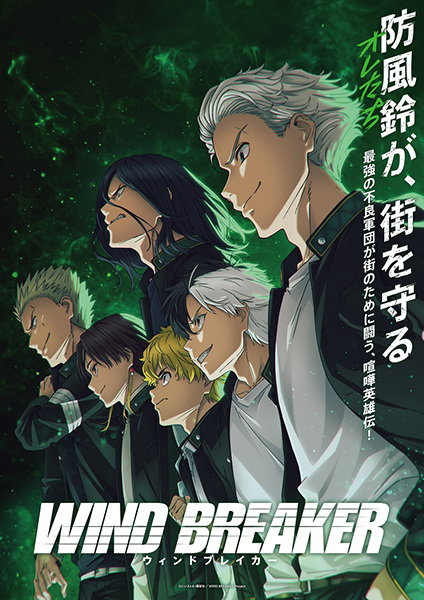

Wind Breaker had everything going against it when it was announced. The genre — delinquent boys fighting each other and protecting their town — is so well-worn that every new entry needs to do something distinctive to stand out. Wind Breaker does that. It is not just another brawling show. It is a story about what it means to belong somewhere, and it handles that theme with more sincerity than the premise suggests.
I went into Wind Breaker expecting to be entertained by good fight choreography and leave it at that. I came out genuinely invested in the characters and looking forward to Season 2 immediately. That is not a small thing.
What Wind Breaker Is Actually About
The protagonist is Haruka Sakura, a student who transfers to Furin High School specifically because of its reputation as a school full of delinquents who protect their town from outside thugs. He is strong, he knows he is strong, and he has spent his entire life fighting alone because of how he looks — striking hair and features that made him a target rather than a friend from a young age.
Furin's student body, called Bofurin, operates as a genuine community rather than just a gang. They patrol their town, protect residents, and take fights to preserve something rather than just to win. This is the key inversion that makes Wind Breaker interesting. Most delinquent anime are about dominance — who is stronger, who rules the territory. Wind Breaker is about protection and belonging, with the fights as the mechanism through which characters earn and demonstrate their values.
Sakura has never had a home. Furin offers him one, and watching him accept that offer — slowly, resistantly, and then wholeheartedly — is the emotional core of the series. It is handled without sentimentality, which is what makes it land.
The Supporting Cast
Wind Breaker has a large cast and manages them well. Toma Hiragi, the de facto leader of Bofurin, is immediately compelling — calm, perceptive, and genuinely kind in a way that does not come across as soft. The ensemble around him includes specific personalities rather than types, which is rare in ensemble action anime.
The show is also good at demonstrating competence without taking it for granted. When characters win fights, you understand why. When they lose, you understand why. The power scaling feels grounded in the early episodes, and the show is careful not to inflate its protagonist into someone invincible too quickly.
Fight Choreography
CloverWorks animated Wind Breaker and the result is impressive. The fights feel physical in a way that wire-work superhero anime rarely achieves. These are people hitting each other with their bodies, and the animation communicates weight and impact rather than just movement. Some of the one-on-one fights in the latter half of Season 1 are among the best-directed fights I watched in 2024.
The show uses its color palette well during action sequences. Sakura's distinctive hair makes him easy to track in chaotic scenes, which sounds like a small thing but actually matters for fight readability.
The sound design deserves credit too. Punches land with real weight, the voice cast sells the exhaustion of a long fight rather than shouting through it, and the score knows when to drop out entirely and let the impacts carry a scene. Yuma Uchida's performance as Sakura in particular gives the character an edge of vulnerability under the bravado that the animation alone could not communicate. It is the kind of production polish that separates a good adaptation from a great one.
Season 2
Season 2 arrived in 2025 and expanded the threat facing Furin. The scale increases, new antagonists are introduced, and the show starts asking harder questions about what Bofurin's mission actually requires of its members. It is a natural continuation rather than a retread, and the character work from Season 1 pays dividends throughout.
What Wind Breaker Gets Right
The show's biggest achievement is making its delinquent characters feel like people rather than archetypes. Sakura's backstory is not unusual for the genre — isolated kid with no family, raised on fighting — but the show presents it without melodrama and moves past it to show who he is becoming rather than dwelling on who he was. The relationships he builds at Furin feel earned because the show takes time to build them.
The theme of protecting something rather than conquering something runs through every arc. Fights happen because something is being threatened, not because someone needs to prove who is stronger. That reframe changes how the violence reads — it feels purposeful rather than gratuitous.
Who Should Watch Wind Breaker
If you liked Tokyo Revengers for the delinquent setting but were frustrated by the time travel complications, Wind Breaker gives you the gang dynamics and fighting without those complications. If you liked Haikyuu for its team dynamics and character relationships, Wind Breaker operates with similar emotional intelligence applied to a street-fighting context.
It is accessible to viewers who are not hardcore action anime fans. The fights are good but they are not the only reason to watch, and the character work holds up independent of the action.